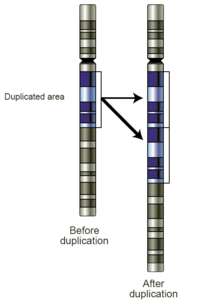
allele |
Alternative form of a gene (one member of a pair) that is located at a specific position on a specific chromosome.

|
| codominance | A condition in which both alleles of a gene pair in a heterozygote are fully expressed, with neither one being dominant or recessive to the other.
|
continuous variation
dihybrid
cross |
The outcome of the number of enviromental factors influencing the expression of traits in a population.

experiment between P generation organisms that differ in two traits.
 |
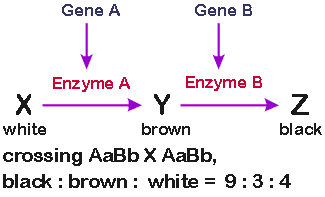
| epistasis | is when one gene hides the expression of another gene.
|
| F1 | The offspring of an initial genetic cross.
 |
| F2 | The offspring of parents who are the first filial generation from a genetic cross.
 |
| gene | Unit of information for a heritable trait, passed from parents to offspring.
 |
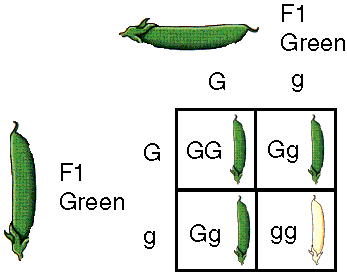
| genotype | The combination of alleles located on homologous chromosomes that determines a specific characteristic or trait
 |
heterozygous |
refers to having two different alleles (one dominant and the other one recesive) for a single trait. |
homozygous dominant |
Having a pair of dominant alleles at a gene locus (on a pair of homologous chromosomes).
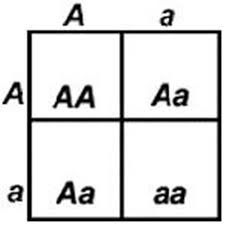 AA is homozygous dominant.
Aa is heterozygous.
aa is homozygous recesive.
|
| homozygous recessive | Having a pair of recessive alleles at a gene locus (on a pair of homologous chromosomes).
|
| hybrid offspring | Of a genetic cross, offspring having a pair of nonidentical alleles for a trait.
 |
| incomplete dominance | Condition in which one allele of a pair is not fully dominant.
 |
independent assortment
|
traits are transmitted to offspring independently of one another.
|
monohybrid cross
| experiment between P generation rganisms that differ in one trait.
|
| multiple allele system | is when there are more than two possible allele pairs for a single locus.
|
| phenotype | Observable trait or traits of an individual that arise from gene interactions and gene-environment interactions.
 |
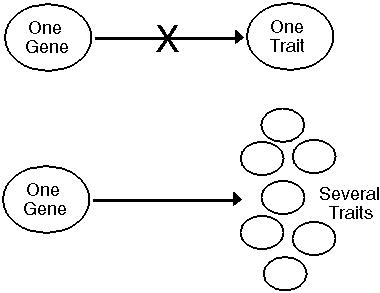
pleiotropy
|
The control of more than one phenotypic characteristic by a single gene or set of genes.
|
| probability | The chance that each outcome of a given event will occur is proportional to the number of ways the outcome can be reached.
|
Punnett-square method
segregation | Construction of a simple diagram as a way to predict probable outcomes of a genetic cross.

states that allele pairs separate or segregate during gamete formation, and randomly unite at fertilization.
 |
| testcross | Experimental cross to determine whether an individual of unknown genotype that shows dominance for a trait is either homozygous dominant or heterozygous.
 |
| true-breeding lineage | a lineage in which only one version of a trait appears over the generations in all parents and their offspring
|