 |
| denotes the presence of two populations of cells with different genotypes in one individual who has developed from a single fertilized egg |
 |
| Linkage group: all genes on a chromosome |
 |
| Abortion: premature exit of the products of conception |
 |
| Aneuploidy: abnormal number of chromosomes, and is a type of chromosomes abnormality. |
| Autosome: chromosome that is not a sez chromosome. |
 |
| Crossing over: process occurring during meiosis wherein two chromosomes pair up and exchange segments of their genetic material. |
 |
| deletion: mutation in which a part of a chromosome or a sequence of DNA is missing. |
 |
| Disease: abnormal condition affecting the body of an organism. |
 |
| Inversion: Part of a chromosome that became oriented in reverse, with no molecular loss. |
| karyotype: is the number and appearance of chromosomes in the nucleus of a eukaryotic. |
 |
| Nondisyunction: failure of chromosome pairs to separate properly during cell division. |
 |
| Polyploidy: is a term used to describe cells and organism containing more than two paired sets of chromosomes. |
 |
| Reciprocal: breeding experiment designed to test the role of parental sex on a given inheritance pattern. |
 |
| Sex chromosome: determine the sex of an organism |
 |
| Syndrome: A set of symptoms that may not individually be a telling clue but collectively characterize a genetic disorder or disease. |
 |
| Translocation: chromosome abnormality caused by rearrangement of parts between nonhomologous chromosome. |
 |
| Double-blind study : is one in which neither the patient nor the physician knows whether the patient is receiving the treatment of interest or the control treatment. |
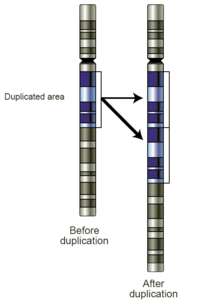 |
| Duplication: gene sequence repeated several to many hundreds or thousands of times. |
 |
| Gentic abnormality: a disease or disorder that is inherited genetically. |
 |
| Genetic disorder: illness caused by abnormalities in genes or chromosomes. |
 |
| Genetic recombination: is a process by which a molecule of nuclei acid is broken and then joined to a different one. |
 |
| Homologous chromosomes: are chromosome pairs of the same length, centromere position, and staining pattern, with genes for the same characteristics at corresponding loci. |
 |
| In-vitro vertilization: conception outside the body. |
X Chromosome: A type of sex chromosome. An XX mammalian embryo becomes female; an XY pairing causes it to develop into a male. | |
Y Chromosome: A type of sex chromosome. An XX mammalian embryo becomes female; an XY pairing causes it to develop into a male.  |

No hay comentarios:
Publicar un comentario